Consumer gaming · Growth · Retention
Creating a Sustained Growth Engine When There Was No Brand Equity
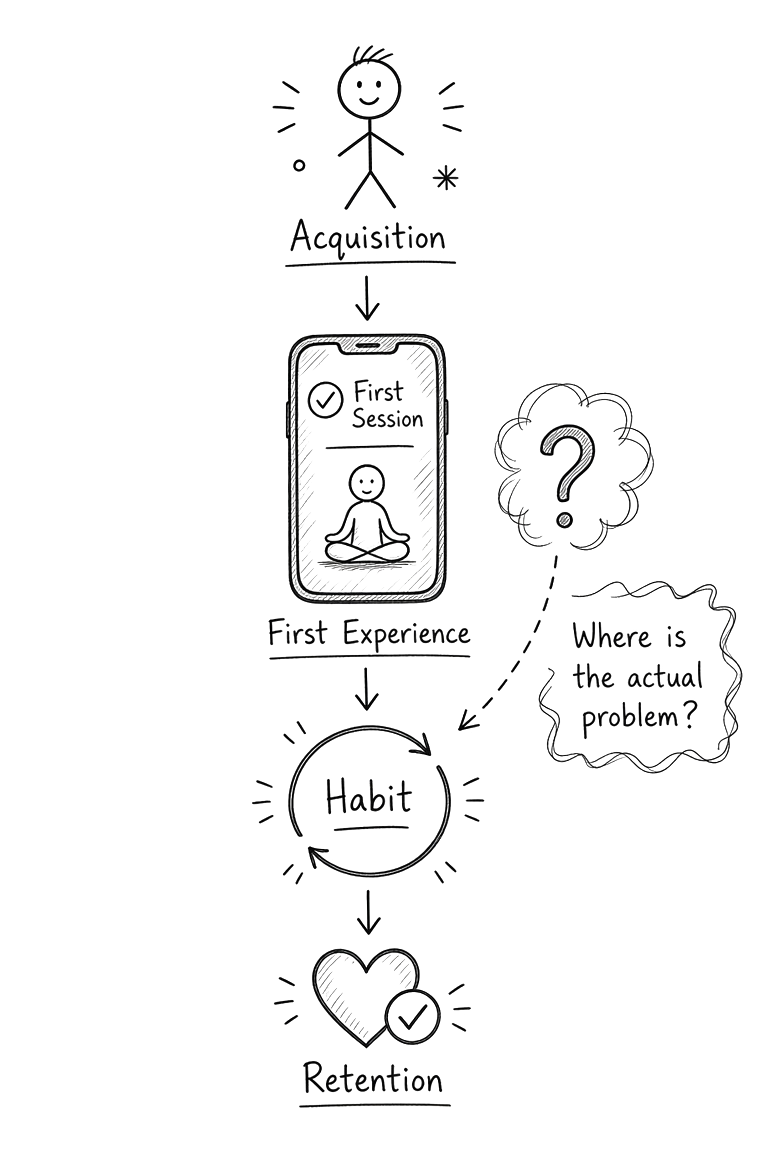
Acquisition was scaling. Retention wasn't.
I worked on a free-to-play casual mobile game entering a market where the company had no established brand.
Early retention wasn't where it needed to be. Acquisition was scaling, but bringing more people into the funnel wasn't fixing the underlying problem.
The aggregate numbers weren't enough to explain why.
The aggregate numbers weren't enough to explain why.
Were we acquiring the wrong users?
Or was the product failing to convert good users into habitual ones?
I followed the user beyond the acquisition metric.
I stopped treating acquisition and retention as separate metrics and followed users through the funnel instead.
That surfaced two different sources of friction.
Some acquisition sources looked efficient on a blended basis, but were quietly bringing in users who behaved differently once they were inside the product.
Separately, the first session was creating friction before anyone had a real chance to experience the core game.
Neither problem was new on its own. What was new was seeing that the blended numbers had been hiding both of them at once.
We changed what we optimized for.
The response wasn't to spend more.
The acquisition mix got evaluated by the quality of the users each source produced, not their cost alone, and the first session got simplified around getting a new player to the core game faster.
A separate layer of work focused on spotting early signs that a player was at risk of dropping off, so the team could respond to that group specifically instead of treating every new player the same way.
The result went beyond retention.
The product moved from a below-benchmark early retention rate to one of the stronger performers in its category, without an established brand to fall back on.
It reached the #4 spot in its category in that market within three months.
The more lasting change was that the business stopped treating acquisition and retention as separate problems to be optimized independently.
The takeaway
Acquisition efficiency is meaningless if you stop measuring at acquisition.
The cheapest user to acquire isn't necessarily the most valuable. What matters is what that user does after the install.
And a retention problem isn't always a retention problem. Sometimes it starts before the user has had a chance to experience the product.
Company names and role titles are public through my résumé and LinkedIn, so they're named directly. Product names, campaign details, and exact internal figures stay out, out of respect for confidentiality obligations to past employers. The reasoning here is real. The implementation detail underneath it isn't.